

Do HEPA ULPA filters require a power source?
Do HEPA ULPA filters require a power source?
As a supplier of HEPA and ULPA filters, I often get asked whether these high - performance filters need a power source. To fully understand this, we first need to have a clear understanding of what HEPA and ULPA filters are and how they function.
HEPA (High - Efficiency Particulate Air) filters are designed to capture at least 99.97% of particles that are 0.3 micrometers in diameter. ULPA (Ultra - Low Penetration Air) filters are even more efficient, capable of capturing 99.999% or more of particles 0.12 micrometers in size. These filters are widely used in various industries, such as healthcare, semiconductor manufacturing, and cleanrooms, where maintaining a high level of air purity is crucial.
In their most basic form, HEPA and ULPA filters do not require a power source. They operate on the principle of mechanical filtration. When air passes through the filter media, particles are trapped by several mechanisms, including interception, impaction, and diffusion. Interception occurs when a particle following a streamline of air comes into contact with a fiber in the filter media and sticks to it. Impaction happens when larger particles are unable to follow the curved path of the air around the fibers and collide with them. Diffusion is the random movement of very small particles, which increases their chances of hitting the filter fibers.
However, for these filters to work effectively, there must be a flow of air through them. This is where the concept of a power source often comes into play. In most practical applications, a fan or a blower is used to create the necessary air movement. These devices require electricity to operate. For example, in a residential air purifier that uses a HEPA filter, a built - in fan draws air into the unit, forces it through the HEPA filter, and then expels the clean air back into the room. In a commercial cleanroom, large - scale ventilation systems with powerful blowers are used to ensure a continuous and high - volume flow of air through the ULPA filters.
Let's take a closer look at different scenarios where the use of power sources varies.
In some simple, passive HEPA filter setups, such as a HEPA filter panel used in a natural ventilation system, there is no dedicated power source for the filter itself. The air movement is driven by natural forces like wind or the stack effect (the movement of air due to differences in temperature and pressure). While these setups can provide some level of air filtration, their efficiency is limited because the air flow rate is often low and inconsistent.
On the other hand, in more advanced and demanding applications, power - driven systems are essential. For instance, in semiconductor manufacturing plants, where even the tiniest particle can cause defects in the microchips being produced, ULPA filters are used in conjunction with complex air handling units. These units have high - capacity fans that can generate a large amount of air pressure to push air through the dense ULPA filter media at a high rate. The power consumption of these systems can be significant, but it is a necessary cost to maintain the extremely clean environment required for semiconductor production.
When it comes to the types of HEPA and ULPA filters we offer as a supplier, each has its own characteristics and potential power - related requirements.
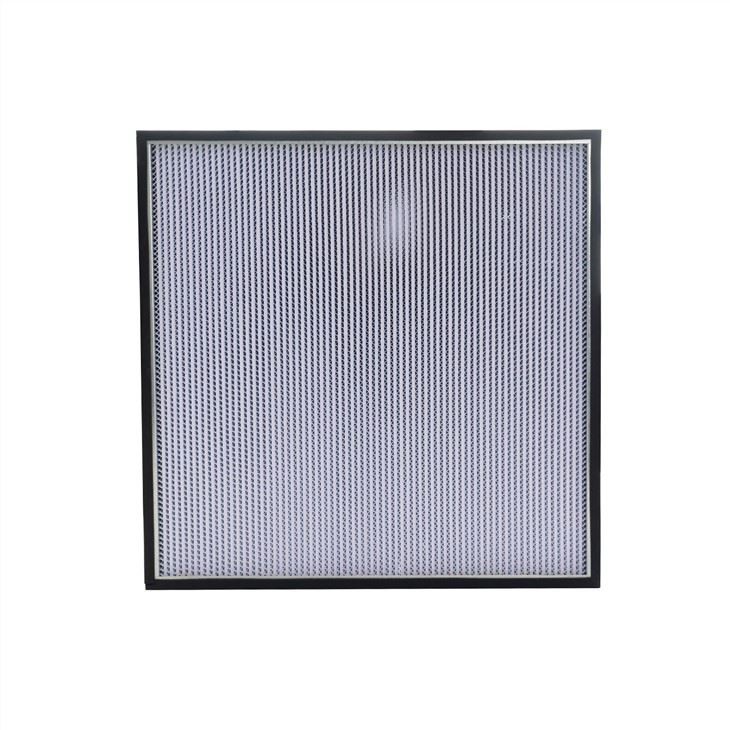

The High Efficiency Filter With Separator is designed with separators between the filter media pleats. These separators help to maintain the shape of the pleats and ensure a uniform air flow through the filter. In most cases, when used in a ventilation system, it will rely on a power - driven fan or blower to achieve the desired air flow rate. The efficiency of this filter can be maximized when there is a consistent and sufficient air flow, which is typically provided by a powered air - moving device.
The Sub High Efficiency Filter With Partition is a step below the HEPA and ULPA filters in terms of efficiency but still offers a good level of air filtration. It is often used in less critical environments where the air quality requirements are not as strict. Similar to the high - efficiency filter with separator, it usually requires a power source in the form of a fan or blower to operate effectively in a ventilation system. The partition design helps to guide the air through the filter media, but without proper air movement, its performance will be compromised.
The PTFE HEPA Air Filter is a specialized type of HEPA filter that uses PTFE (Polytetrafluoroethylene) as the filter media. PTFE has excellent chemical resistance and low friction properties, which can improve the overall performance of the filter. In applications where this filter is used, such as in chemical processing plants or laboratories, a power - driven ventilation system is typically required to ensure that the air containing potentially harmful chemicals or particles is effectively filtered.
As a supplier, we understand that the decision to use a power - driven system with HEPA or ULPA filters depends on several factors. These include the specific application, the required air flow rate, the level of air purity needed, and the available budget for energy consumption. For customers who are looking for a cost - effective solution with lower energy requirements, passive or low - power filter setups may be considered. However, for applications where strict air quality standards must be met, a power - driven system is often the only viable option.
If you are in the market for HEPA or ULPA filters and are unsure about the power requirements for your specific application, our team of experts is here to help. We can provide detailed information about the different types of filters we offer, their performance characteristics, and the most suitable ventilation systems to use with them. Whether you are setting up a small - scale air purification system in your home or a large - scale cleanroom for industrial production, we can work with you to find the best solution that meets your needs and budget. Contact us to start a discussion about your filter requirements and let's work together to create a cleaner and healthier environment.
References
- "Fundamentals of Air Filtration" by George C. Walton and William C. Revzan.
- "Cleanroom Design and Operation" by Larry D. Lindsay.
- Industry standards and guidelines from organizations such as the American Society of Heating, Refrigerating and Air - Conditioning Engineers (ASHRAE) and the International Organization for Standardization (ISO).