

What is the surface area of F8 V bank filters?
Hey there! As a supplier of F8 V bank filters, I often get asked about the surface area of these filters. So, I thought I'd take a moment to break it down for you.
First off, let's talk about why the surface area of an F8 V bank filter matters. The surface area plays a crucial role in the filter's performance. A larger surface area means more space for the filter to capture dust, dirt, and other particles from the air. This results in better filtration efficiency and a longer lifespan for the filter. In other words, it can save you money in the long run by reducing the frequency of filter replacements.
Now, to calculate the surface area of an F8 V bank filter, we need to understand its structure. An F8 V bank filter is made up of multiple filter pockets arranged in a V-shaped configuration. Each pocket has a certain width, height, and depth, and these dimensions are used to determine the total surface area.
The basic formula for calculating the surface area of a single pocket is 2 * (width * height + width * depth + height * depth). However, since the F8 V bank filter has multiple pockets, we need to multiply this value by the number of pockets in the filter.
Let's say we have an F8 V bank filter with 10 pockets. Each pocket has a width of 20 cm, a height of 50 cm, and a depth of 10 cm. Using the formula above, the surface area of a single pocket would be:
2 * (20 * 50 + 20 * 10 + 50 * 10) = 2 * (1000 + 200 + 500) = 2 * 1700 = 3400 square centimeters.
To find the total surface area of the 10 - pocket F8 V bank filter, we multiply the surface area of a single pocket by the number of pockets: 3400 * 10 = 34000 square centimeters.
It's important to note that this is a simplified calculation. In reality, the actual surface area may vary depending on factors such as the shape of the pockets, the presence of any folds or pleats, and the way the pockets are arranged in the V - bank.
When it comes to choosing the right F8 V bank filter for your needs, the surface area is just one factor to consider. You also need to think about the filter's efficiency rating, which indicates how well it can capture particles of different sizes. The F8 rating means that the filter can capture at least 80% of particles in the size range of 0.4 - 1.0 microns.

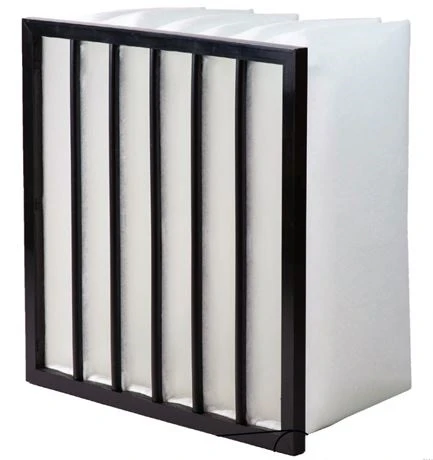
Another important consideration is the airflow resistance of the filter. A filter with a large surface area may have lower airflow resistance, which means it allows air to pass through more easily. This can result in lower energy consumption for your ventilation system.
If you're looking for other types of filters, we also offer Reverse Rigid Pocket Filters, Rigid Pocket Filter, and Plastic Air Filter. These filters have their own unique features and benefits, and the surface area calculation methods may also differ slightly.
At the end of the day, if you're in the market for F8 V bank filters or any of our other products, I'd love to chat with you. Whether you have questions about surface area, efficiency ratings, or just need some advice on which filter is right for your specific application, I'm here to help.
Don't hesitate to reach out if you're interested in purchasing our filters. We can work together to find the best solution for your ventilation and air - filtration needs. Whether it's a small - scale project or a large industrial application, we've got you covered.
References
- General knowledge of air filter technology and calculations
So, if you've got any thoughts or questions, drop me a line and let's start the conversation about getting the perfect air filters for you!