

What size of particles can H14 HEPA PTFE filter capture?
Hey there! As a supplier of H14 HEPA PTFE filters, I often get asked about the particle sizes these filters can capture. So, let's dive right into it and explore the ins and outs of H14 HEPA PTFE filters and their particle - capturing capabilities.
First off, let's understand what an H14 HEPA PTFE filter is. HEPA stands for High - Efficiency Particulate Air, and it's a standard that indicates a very high level of filtration efficiency. The H14 rating is one of the highest in the HEPA classification. PTFE, on the other hand, is Polytetrafluoroethylene. It's a synthetic fluoropolymer that has some amazing properties, like being hydrophobic, chemical - resistant, and having a very low friction coefficient. When you combine the high - efficiency HEPA standard with the unique properties of PTFE, you get a filter that's top - notch in the air - filtration game.
Now, onto the main question: what size of particles can an H14 HEPA PTFE filter capture? Well, an H14 HEPA filter is designed to capture at least 99.995% of particles that are 0.3 microns in diameter. That might not seem like a lot, but 0.3 microns is incredibly small. To put it into perspective, a human hair is about 70 microns in diameter. So, these filters can catch particles that are way, way smaller than the width of a human hair.
But here's the thing. The 0.3 - micron mark is actually the "most penetrating particle size" (MPPS). Particles that are larger or smaller than 0.3 microns are actually easier for the filter to capture. For particles larger than 0.3 microns, they're more likely to be trapped by the filter fibers through a process called impaction. When these larger particles are carried along by the air stream, they're too big to follow the air as it curves around the filter fibers, so they crash into the fibers and get stuck.
For particles smaller than 0.3 microns, they're captured through a process called diffusion. These tiny particles are constantly jiggling around due to Brownian motion. As they move randomly, they're more likely to come into contact with the filter fibers and get captured.
In practice, an H14 HEPA PTFE filter can capture particles as small as 0.1 microns with an extremely high efficiency. Some of the common particles that these filters can trap include dust mites, pollen, mold spores, bacteria, and even some viruses. Dust mites are usually around 100 - 400 microns in size, so they're easily caught by the filter. Pollen grains can range from 10 - 100 microns, and they're no match for the H14 HEPA PTFE filter either.
Bacteria are typically between 0.5 - 5 microns in size. So, whether it's E. coli, which is about 2 microns long, or Staphylococcus aureus, which is around 1 micron in diameter, the filter can capture them effectively. When it comes to viruses, things get a bit more challenging because they're extremely small. Some viruses, like the influenza virus, are around 0.1 microns in size. And as I mentioned earlier, an H14 HEPA PTFE filter can capture particles as small as 0.1 microns with high efficiency, so it can play a crucial role in reducing the spread of these viruses in the air.
The unique properties of PTFE in these filters also contribute to their excellent performance. PTFE has a very porous structure, which allows air to flow through easily while still capturing particles. It's also resistant to moisture, so it won't get clogged up as easily as some other filter materials when there's humidity in the air. This means that the filter can maintain its high - efficiency performance over a longer period of time.
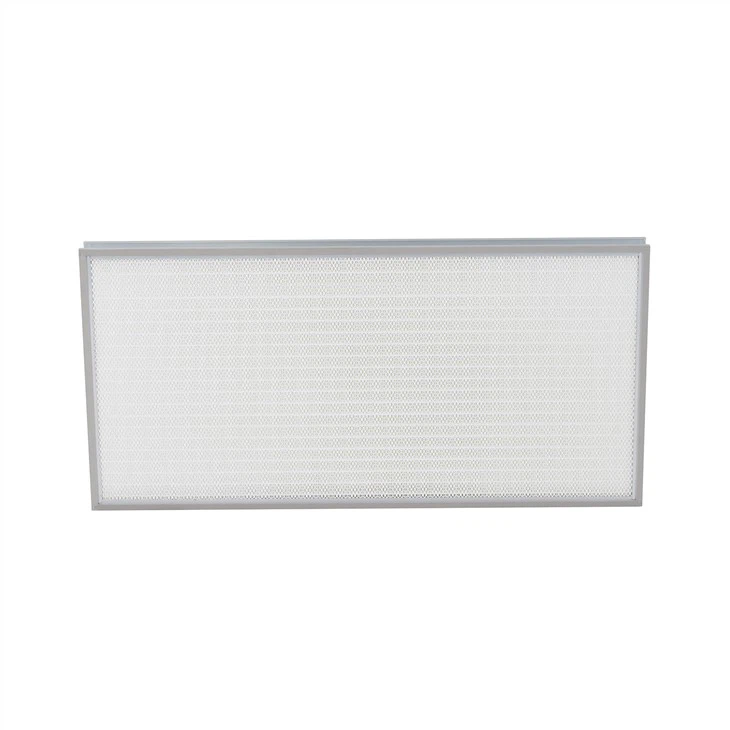
If you're in the market for high - quality air filtration, you might be interested in our PTFE HEPA Filter. It's designed to meet the strict H14 HEPA standards and uses PTFE to provide superior particle - capturing capabilities. And if you want to learn more about HEPA filter air filtration in general, check out our HEPA Filter Air Filtration page.
We also offer Gel Sealing HEPA ULPA Filter, which provides an extra - tight seal to prevent any unfiltered air from bypassing the filter. This is especially important in applications where you need the highest level of air purity, like in cleanrooms or hospitals.
Whether you're running a manufacturing facility that needs to keep the air free of contaminants, a hospital that wants to prevent the spread of airborne diseases, or just a homeowner looking for better indoor air quality, our H14 HEPA PTFE filters are a great choice. They offer reliable, long - lasting performance and can make a real difference in the air you breathe.
If you're interested in purchasing our H14 HEPA PTFE filters or have any questions about our products, don't hesitate to reach out. We're always happy to have a chat, answer your questions, and help you find the right filter for your specific needs. Let's work together to make the air cleaner and healthier!
References

- "Fundamentals of Air Filtration" by Klaus Willeke and Philip A. Baron
- "Air Filtration: An Integrated Approach to the Theory and Application of Fibrous Filters" by Larry K. Walker, Philip A. Baron, and Klaus Willeke