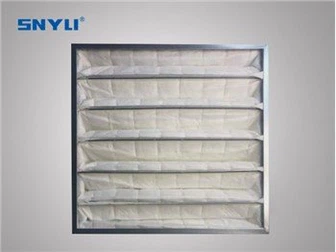
Hepa 13 Air Filter Maintenance Tips
How can we maintain the Hepa 13 Air Filter Maintenance Tips First, let's understand what a high-efficiency filter is the high-efficiency filter is mainly used to capture dust particles below 0.3um and various suspended solids. It uses ultra-fine glass fiber paper as filter material, offset paper, aluminum film and other materials as partition plates, and is made of high-efficiency filter outer frame. Each unit has been tested and has the characteristics of high filtration efficiency, low resistance, and large dust holding capacity. How to maintain the high-efficiency filter.
Before installing the high-efficiency filter, it is not allowed to tear or open the packaging bag or packaging film by hand. The air filter should be stored strictly in accordance with the direction marked on the high-efficiency filter packaging box; during the transportation of the high-efficiency air filter, it should be handled and placed gently to avoid severe vibration and collision.
The transportation and storage of the high-efficiency filter should be placed in the direction marked by the manufacturer. During transportation, it should be handled and placed gently to prevent severe vibration and collision, and forced loading and unloading is not allowed.
Before installing the high-efficiency filter, the package must be unpacked for appearance inspection at the installation site, including: whether the filter paper, sealant and frame are damaged; whether the side length, diagonal and thickness dimensions meet the requirements; whether the frame has burrs and rust spots (metal frame); whether there is a product certificate, and whether the technical performance meets the design requirements. Then check according to the method specified in the national standard "Clean Room Construction and Acceptance Specifications" [JGJ71-90], and those that are qualified should be installed immediately.
For high-efficiency filters, the installation direction must be correct: when the corrugated plate combination filter is installed vertically, the corrugated plate must be perpendicular to the ground; the connection between the filter and the frame in the vertical direction is strictly prohibited from leakage, deformation, breakage and glue leakage, etc. After installation, the inner wall must be kept clean, free of floating dust, oil stains, rust and debris. .
Inspection method: observation or white silk cloth wiping inspection.
Before installing the high-efficiency filter, the clean room must be thoroughly cleaned and wiped clean. If there is dust accumulation inside the purification air conditioning system, it should be cleaned and wiped clean again to meet the cleaning requirements. If a hepa air filter h13 is installed in the technical mezzanine or ceiling, the technical layer or ceiling should also be thoroughly cleaned and wiped.
Hepa 13 air purifier used in clean rooms with cleanliness levels equal to or higher than Class 100 should be leak-checked according to the prescribed methods before installation and meet the prescribed requirements.
For high-efficiency filters, when the resistance value of the h13 h14 hepa filters is greater than 450Pa; or when the air flow velocity on the air outlet surface is reduced to the minimum, even after replacing the coarse and medium efficiency filters, the air flow velocity cannot be increased; or when there is an irreparable leakage on the surface of the high-efficiency filter, a new high-efficiency filter must be replaced; if the above conditions are not met, it can generally be replaced every 1-2 years according to the use environment conditions.
For the leak detection method of the high-efficiency filter, the sampling head of the particle counter must be inserted into the exhaust static pressure box (or duct) connected to the exhaust high-efficiency filter (this is different from the scanning leak detection of the supply h13 filter, because the leak detection side of the supply air high-efficiency filter is exposed to the room, while the leak detection side of the exhaust air high-efficiency filter is hidden deep in the static pressure box or duct) before scanning leak detection can be performed on the leak detection side of the exhaust air high-efficiency filter according to the above-mentioned method.

----------------------------What are the replacement process and precautions for high-efficiency filters in clean areas----------------------------
Before installing high-efficiency filters in clean areas, the clean room must be thoroughly cleaned and wiped. If there is dust inside the purification air conditioning system, it should be cleaned and wiped again to meet the cleaning requirements. If a filter h13 hepa is installed in a technical mezzanine or ceiling, the technical mezzanine or ceiling should also be thoroughly cleaned and wiped.
After the clean room and purification air conditioning system meet the cleaning requirements, the purification air conditioning system must be tested and run continuously for more than 12 hours. After cleaning and wiping the clean room again, install the high-efficiency filter in the clean area immediately. The transportation and storage of high-efficiency filters should be shelved in the direction of the manufacturer's logo. During transportation, they should be handled with care to prevent severe vibration and collision. Before installation, the packaging must be unpacked at the installation site for appearance inspection, including whether the filter paper, sealant and frame are damaged, whether the side length, diagonal and thickness dimensions meet the requirements, whether the frame has burrs and rust spots (metal frame), whether there is a product certificate, and whether the technical performance meets the design requirements.
Then, leak detection is carried out. Those that pass the inspection and leak detection should be installed immediately. During installation, reasonable adjustments should be made according to the resistance of each filter. The frame for installing the high-efficiency filter in the clean area should be flat. The allowable deviation of the flatness of the installation frame of each high-efficiency filter is no more than 1mm.
----------------------------High-efficiency filters have three working principles----------------------------
Inertial diffusion and interception principle: There are hundreds of millions of dust particles in the air, which sometimes move inertially with the airflow, and sometimes move irregularly. When dust particles hit other objects during various movements and movements, they will stick to them. The dust particles in the filter have a greater chance of collision, and small dust condenses into large dust. Large dust will sink due to its heavy weight, so the effect of crystallization air can be expected.
Electrostatic effect: The static electricity in the filter can make the dust change its trajectory and hit obstacles, and the static electricity can make the dust stick to the medium more firmly. This electrostatic effect can significantly improve the filtering effect.
Chemical filtration: Whether it is a high-efficiency filter without a partition or a high-efficiency filter with a partition, there is activated carbon material inside, which has a large adsorption area and strong adsorption force.
The standard of high-efficiency air filter has the characteristics of high filtration efficiency, large air volume, low resistance, uniform wind speed, and economical and practical. It adopts a partition design, with aluminum alloy, wood board, galvanized plate and stainless steel as the outer frame, ultra-fine glass filter paper as the filter material, offset paper or aluminum foil as the separator, and corrugated partition can accurately maintain the pleat spacing, effectively making the partition high-efficiency air filter with minimum resistance and maximize the use of filter material. When working, it can prevent air leakage and capture 0.3μm particles with an efficiency of up to 99.99%.

The initial resistance of the Hepa 13 Air Filter Maintenance Tips refers to the air flow resistance of the newly made filter under the rated air volume state. When the air filter operates at a certain air volume, its flow resistance increases with the increase of dust accumulation. Generally, when the dust accumulation reaches a certain value, the resistance increases rapidly. At this time, the filter should be replaced or cleaned to ensure the economic operation of the purification air conditioning system. Generally speaking, the initial resistance of the high-efficiency filter is around 150-220PA. "
The initial resistance of a high-efficiency filter is called "initial resistance", and the resistance value corresponding to the scrapping of the filter is called "final resistance". When designing, a representative resistance value is required, which is called "design resistance". The general method is to take the average of the initial resistance and the final resistance. In most cases, the final resistance of a high-efficiency filter is 2 to 4 times the initial resistance. Table 3-1 gives some recommended final resistances. When the filter reaches the final resistance, it means that the filter must be replaced. A resistance monitoring device can be installed in each filter section to determine it, such as a differential pressure gauge.
Recommended value of final resistance of air filter.
Filter efficiency specification recommended final resistance/Pa".
Coarse efficiency 100~200
Medium efficiency 250~300
High efficiency 300~400
Sub-high efficiency 400~450
High efficiency 400-600
The different choices of initial resistance of high-efficiency filters are also related to the application environment.
Keywords: best h13 air purifier | hepa 13 filter air purifier | h13 filter air purifier | air purifier hepa h13 | hepa h13 h14 | h13 h14 hepa filters