Leak Detection Method Of Air Filter In Pharmaceutical Factory
Leak Detection Method Of Air Filter In Pharmaceutical Factory is a very rigorous industry. As a factory that manufactures drugs, it has very strict requirements on all aspects of the environment. There are generally three filtrations in the air filtration of pharmaceutical factories, that is, junior and secondary filtration are used in combination with high efficiency to meet the production environment requirements of pharmaceutical factories. Then it is also very necessary to detect leaks of high-efficiency filters during use.
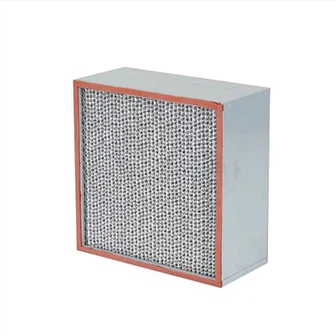
High-quality products are inseparable from a high-quality production environment. In the pharmaceutical industry, in order to meet the process parameter requirements of the clean area, many public facilities need to work together, and the most important thing in the pharmaceutical clean room is the high-efficiency filter. High-efficiency filter (HEPA) generally refers to an air filter that has a collection efficiency of more than 99.9% for particles with a particle size of 0.3um or more and an initial airflow resistance of less than 250Pa. It is usually used as the terminal filtration device of the air conditioning system in the clean workshop of pharmaceutical companies. It is used to provide clean air that meets the requirements of the clean room. Whether a clean room can achieve and maintain the designed cleanliness level is closely related to the performance of the high-efficiency filter and its correct installation method to a certain extent. Therefore, on-site leak detection testing of high-efficiency filters in clean production workshops to ensure that they meet the requirements is an important detection method to ensure the clean environment level of the workshop.
Leak Detection Method Of Air Filter In Pharmaceutical Factory is mainly the following two points:
1. Check whether the material of the high-efficiency filter is damaged or leaking;
2. If the outer frame size and material requirements are met or not, do not affect the installation.
High-efficiency filters are tested by professional testing equipment before leaving the factory, and are accompanied by a filter efficiency report and certificate of compliance. High-efficiency filter leak detection refers to on-site leak detection of high-efficiency filters and their systems in pharmaceutical factories after they are installed. It mainly checks for small pinholes and other damage in the filter material, such as frame seals, gasket seals, and cracks on the filter frame. Leakage etc. The purpose of leak detection is to promptly discover defects in the high-efficiency filter itself and its installation by checking the sealing of the high-efficiency filter and its connection with the installation frame, and take corresponding remedial measures to ensure the cleanliness of the area.
Test methods include:
1. Aerosol photometer test method
2. Particle counter test method
3. Full efficiency test method
4. External air test method

Precautions and acceptance criteria for high-efficiency filters in pharmaceutical factories:
1. Any continuity reading exceeding 0.01% is considered a leak. Each high-efficiency air filter must not leak after testing and replacement, and the frame must not leak.
2. The repair area of each high-efficiency air filter shall not be greater than 3% of the area of the high-efficiency air filter.
3. The length of any repair shall not be greater than 38mm. The area where the airflow actually passes through the filter material is called the "effective filter area". Except for a small number of low-efficiency filters, the effective filtration area is often several or dozens of times the windward side of the filter. Most of the captured dust is concentrated on the windward side of the filter material. The larger the effective filtration area in the filter, the more dust it can hold, and the longer the service life of the filter.
The larger the effective area, the lower the wind speed passing through the unit area, and the smaller the resistance of the filter. Increasing the effective filtration area is the most significant means to extend the service life of the filter. Experience shows that for filters with the same structure and the same filter material, when the final resistance is determined: if the filter material area increases by 50%, the service life of the filter will be extended by 70% to 80%; if it is doubled, the service life of the filter will be extended. It is about 3 times the original size. If there is more filter material, the price of the filter will increase accordingly, but the increase is definitely not as high as the life extension of the high-efficiency filter in a pharmaceutical factory. Furthermore, the effective area is larger, the initial resistance is reduced, and the energy consumption of the system will also be reduced. For users,Leak Detection Method Of Air Filter In Pharmaceutical Factory it is definitely cost-effective to choose a filter with a large effective area. Of course, the possibility of increasing the effective filtration area should be considered based on the specific structure of the filter and site conditions. For example, for bag filters, the number and length of filter bags can be increased; for traditional filters with partitions, you can discuss with the manufacturer to reduce the distance between partitions to increase the number of pleats of filter paper; for projects under design, you can choose The kind of filter that can hold a lot of filter material.
Factory Show: