

How do F7 V bank filters perform in areas with high air pollution?
Hey there! As a supplier of F7 V bank filters, I've gotten a ton of questions about how these bad boys perform in areas with high air pollution. So, I thought I'd sit down and share some insights based on my experience and the science behind these filters.
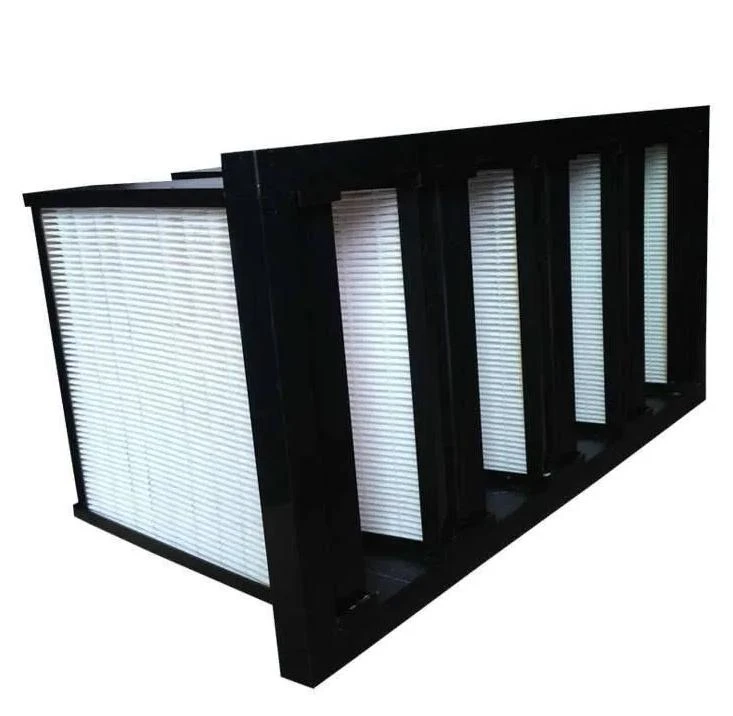
First off, let's talk about what F7 V bank filters are. These filters are a type of air filter that's designed to capture a wide range of particles in the air. The "F7" part refers to the filter's efficiency class. According to the European standard EN 779, F7 filters are classified as medium-efficiency filters. They can capture particles as small as 1 - 10 micrometers with an efficiency of around 60 - 80%. The "V bank" design is a configuration where the filter media is arranged in a V-shaped pattern. This design increases the surface area of the filter, allowing it to capture more particles without causing a significant drop in air flow.
Now, let's dive into how these filters perform in high-pollution areas. In places where the air is thick with pollutants, such as industrial zones, busy city centers, or regions with a lot of vehicle traffic, the air contains a high concentration of particulate matter (PM). This PM can include dust, smoke, pollen, and other harmful particles. F7 V bank filters are really good at capturing these particles. The large surface area provided by the V bank design means that there's more space for the particles to get trapped. As the polluted air passes through the filter, the particles stick to the filter media, and clean air comes out the other side.
One of the key advantages of F7 V bank filters in high-pollution areas is their durability. The high concentration of pollutants can quickly clog up a filter, reducing its efficiency and lifespan. However, the V bank design helps to distribute the particles more evenly across the filter media. This means that the filter doesn't get clogged up as quickly, and it can continue to perform effectively for a longer period of time. This is especially important in high-pollution areas, where the filters need to work hard to keep the air clean.
Another benefit is that F7 V bank filters can help to improve the overall air quality in a space. By removing a large percentage of the particulate matter from the air, these filters can reduce the risk of respiratory problems, allergies, and other health issues. In high-pollution areas, where the air quality is often poor, this can have a significant impact on the health and well-being of the people living and working in those areas.

But it's not just about the performance of the filters themselves. It's also important to consider the maintenance and replacement schedule. In high-pollution areas, the filters will need to be replaced more frequently than in areas with lower pollution levels. This is because they'll get dirty faster. However, the long lifespan of F7 V bank filters means that the replacement intervals are still relatively reasonable. It's important to follow the manufacturer's recommendations for maintenance and replacement to ensure that the filters are working at their best.
Now, let's compare F7 V bank filters with some other types of filters. For example, the ABS Rigid Pocket Air Filters are another option for air filtration. These filters have a rigid frame that supports the filter media, which can be useful in some applications. However, in high-pollution areas, the F7 V bank filters may be a better choice because of their larger surface area and better particle distribution.
The Sub Efficient Dense Pleat Filter is another type of filter. As the name suggests, these filters are less efficient than F7 filters. They may not be able to capture as many particles in high-pollution areas, which means that the air quality may not be as good.
The Self Supported Pocket Filters are also an option. These filters don't require a separate frame, which can make them more cost-effective in some cases. However, they may not be as durable as F7 V bank filters in high-pollution areas, as they may not be able to withstand the high concentration of particles as well.
In conclusion, F7 V bank filters are a great choice for areas with high air pollution. They offer high efficiency, durability, and the ability to improve air quality. If you're in an area with high pollution and you're looking for a reliable air filtration solution, I highly recommend considering F7 V bank filters.
If you're interested in learning more about our F7 V bank filters or you're looking to make a purchase, I'd love to have a chat with you. Just reach out, and we can start a conversation about how these filters can meet your specific needs.
References
- EN 779:2012. Air filters for general ventilation - Determination of the filtration performance.
- Various industry reports on air filtration and air quality in high-pollution areas.