

How does the impeller design in a DC FFU work?
Hey there! As a supplier of DC FFUs (Direct Current Fan Filter Units), I'm super stoked to dive into how the impeller design in a DC FFU works. It's a crucial part of these units, and understanding it can really help you make the right choice when it comes to your air filtration needs.
Let's start with the basics. The impeller is like the heart of a DC FFU. It's the component that actually moves the air through the unit. When you think about it, air filtration is all about getting the dirty air in and pushing the clean air out, and the impeller is what makes that happen.
The design of the impeller has a huge impact on how well the DC FFU performs. There are a few key factors that go into a good impeller design, and I'll break them down for you.
Blade Shape and Angle
One of the most important aspects of impeller design is the shape and angle of the blades. The blades are what actually interact with the air and give it the push it needs to move through the unit.
There are different types of blade shapes, but two of the most common ones are forward-curved and backward-curved blades. Forward-curved blades are shaped like little scoops. They're great at moving a large volume of air at a relatively low pressure. This means that they can draw in a lot of air quickly, which is really useful in applications where you need to filter a large amount of air in a short period of time.
On the other hand, backward-curved blades are shaped more like the wings of an airplane. They're designed to move air at a higher pressure. This makes them more efficient at pushing the air through the filter and out of the unit. They're also less likely to cause turbulence, which can reduce the noise level of the FFU.
The angle of the blades is also important. A steeper blade angle will generally result in a higher pressure output, but it may also require more power to operate. A shallower blade angle, on the other hand, will produce a lower pressure but will use less energy. The trick is to find the right balance between pressure and power consumption for your specific application.
Impeller Size and Number of Blades
Another factor that affects the performance of the impeller is its size and the number of blades it has. A larger impeller will generally be able to move more air than a smaller one. However, it will also require more space and may use more power.
The number of blades on the impeller also plays a role. More blades can provide a smoother and more consistent airflow, but they can also increase the resistance and make the impeller harder to turn. Fewer blades, on the other hand, can be more efficient but may produce a more pulsating airflow.
When choosing an impeller for your DC FFU, you need to consider the size of the space you're trying to filter and the amount of air you need to move. If you're working in a large room with high air exchange requirements, you may need a larger impeller with more blades. If you're working in a smaller space, a smaller impeller with fewer blades may be sufficient.
Material and Construction
The material and construction of the impeller are also important. Impellers are typically made from materials like plastic, aluminum, or steel. Each material has its own advantages and disadvantages.
Plastic impellers are lightweight and inexpensive. They're also resistant to corrosion, which makes them a good choice for applications where the air may contain moisture or chemicals. However, plastic impellers may not be as durable as metal ones and may break or warp under high stress.
Aluminum impellers are lightweight and have good heat dissipation properties. They're also relatively strong and resistant to corrosion. However, they can be more expensive than plastic impellers.
Steel impellers are the most durable option. They can withstand high temperatures and pressures and are less likely to break or warp. However, they're also the heaviest and most expensive option.
In addition to the material, the construction of the impeller is also important. A well-designed impeller will have a balanced and symmetrical shape to ensure smooth operation. It will also have a tight fit between the blades and the hub to prevent air leakage.
How the Impeller Works with the Motor
The impeller doesn't work alone. It needs to be connected to a motor to turn and move the air. In a DC FFU, the motor is typically a direct current motor, which is more energy-efficient than an alternating current motor.
The motor provides the power to turn the impeller, and the speed of the motor determines how fast the impeller rotates. The faster the impeller rotates, the more air it can move. However, increasing the speed of the motor also increases the power consumption and may generate more noise.
To control the speed of the impeller, most DC FFUs have a variable speed controller. This allows you to adjust the speed of the motor based on your specific needs. For example, you may want to run the FFU at a lower speed when the air is relatively clean and increase the speed when the air is dirty.
The Role of the Impeller in Air Filtration
Now that we've talked about how the impeller works, let's talk about its role in air filtration. The main function of the impeller is to draw in the dirty air from the surrounding environment and push it through the filter.
The filter is the component that actually removes the contaminants from the air. There are different types of filters available, such as Ffu Filter, which can remove different sizes of particles. The impeller needs to be able to provide enough pressure to push the air through the filter without causing too much resistance.
If the impeller doesn't provide enough pressure, the air may not be able to pass through the filter effectively, and the filtration efficiency will be reduced. On the other hand, if the impeller provides too much pressure, it may damage the filter or cause it to clog more quickly.
Different Applications of DC FFUs and Impeller Design
DC FFUs are used in a wide range of applications, from cleanrooms in the semiconductor industry to hospitals and laboratories. Each application has its own specific requirements, and the impeller design needs to be tailored to meet those requirements.
In a cleanroom environment, for example, the FFU needs to be able to provide a high level of air cleanliness and a consistent airflow. This may require a larger impeller with more blades and a higher pressure output. The impeller may also need to be made from a material that is resistant to static electricity to prevent the buildup of dust and particles.
In a hospital or laboratory, the FFU needs to be quiet and energy-efficient. This may require a smaller impeller with fewer blades and a lower pressure output. The impeller may also need to be designed to minimize the generation of noise and vibration.
In some applications, such as Flowhood Fan Filter Unit, the FFU may need to be able to provide a specific airflow pattern. This may require a special impeller design or the use of additional components, such as diffusers or baffles, to control the airflow.

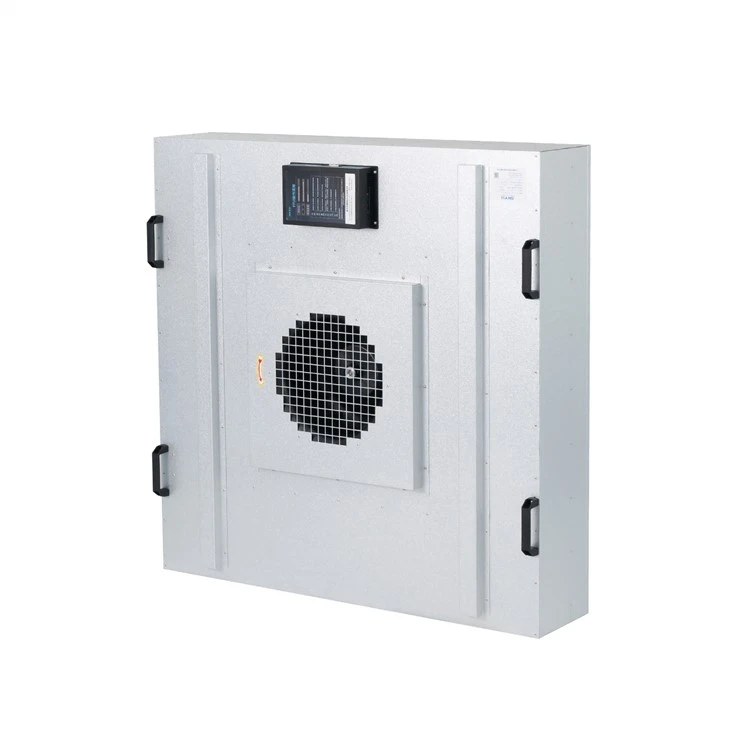
Comparison with Other Types of FFUs
There are other types of FFUs available on the market, such as EC FFU. EC FFUs use electronically commutated motors, which are more energy-efficient and have better speed control than DC motors.
However, DC FFUs still have their advantages. They're generally less expensive than EC FFUs and are easier to install and maintain. The impeller design in a DC FFU can also be optimized to provide a high level of performance at a relatively low cost.
Conclusion
So, there you have it! That's how the impeller design in a DC FFU works. As you can see, it's a complex and important part of the unit that has a huge impact on its performance.
If you're in the market for a DC FFU, I hope this article has given you a better understanding of what to look for in an impeller design. Remember to consider factors like blade shape and angle, impeller size and number of blades, material and construction, and how the impeller works with the motor.
If you have any questions or need help choosing the right DC FFU for your application, don't hesitate to reach out. We're here to help you make the best decision for your air filtration needs. Let's start a conversation and see how we can work together to provide you with the perfect DC FFU solution.
References
- "Fan Engineering", Fourth Edition, Buffalo Forge Company
- "Air Filtration: Principles and Applications", Second Edition, Klaus Willeke and E. William McFarland