Air Filter Percentage Calculation
Air Filter Percentage Calculation One method used to calculate the amount of outdoor fresh air entering a ventilation system is to take a duct section velocity measurement of the outdoor duct inlet. However, this is not always possible because there may not be enough straight duct to take a good duct measurement of the return air or outdoor fresh air. Often, there is not even an outdoor duct, so it is essentially impossible to determine the amount of outdoor fresh air entering the ventilation system.
Another way to determine how much outdoor fresh air is entering a space is to use the following formula:
Fresh Air Volume = Supply Air Volume × Percentage of Outdoor Supply Air (Fresh Air Ratio %OA)
The amount of fresh air entering a space is equal to the supply air volume (ft3/min, m3/hr, m3/min or L/s) multiplied by the fresh air ratio. Let's look at each of these items separately.
----------------------------Total Supply Air----------------------------
Total supply air is the total amount of outdoor air and return air entering a space. To determine the total supply air entering a building, measure using the TA460 or PVM620 Duct Section Method after the AHU and before the duct splits. Another way to determine the total supply air is to use an 8380 (PH721) Capture Hood at each supply diffuser and take the sum of the readings.
----------------------------Percent Outdoor Air----------------------------
Percent Outdoor Air is the percentage of the total supply air that is outdoor air. There is more than one way to measure %OA. One method is to use a tracer gas like SF6. This gas will be used to bring the system to a set saturation concentration and record how the concentration decreases over time. Using this information, one can tell what the %OA is. This can also be done with CO2 if the concentration is high enough and there are no occupants.
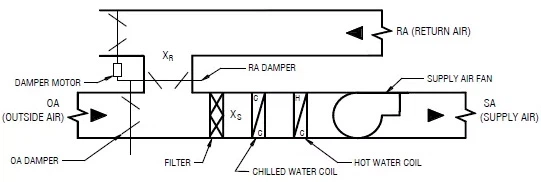
Perhaps a better option is to take three CO2 concentration readings and calculate the %OA. The three reading locations include the outdoor supply, supply, and return air. Another option is to take temperature readings at the same three locations.
Quoted formula.
To calculate the fresh air ratio %OA, use the following CO2 or temperature equation:
Image.
----------------------------Where----------------------------
XR = return air CO2 concentration or temperature
XS = supply air CO2 concentration or temperature
XO = outdoor air CO2 concentration or temperature
When to Use CO2 or Temperature to Calculate Percent Outdoor Air:
Percent outdoor air can be calculated using either CO2 or temperature. Both methods have benefits and it is important to understand when to use one method over the other.
Generally speaking, CO2 should be used when there are many occupants in the building you are interested in. This ensures that the CO2 concentration values for the outdoor air and return air are very different. If there are a sufficient number of occupants, the CO2 concentration for the outdoor air will always be the lowest and the CO2 concentration for the return air will always be the highest. The greater the difference between these two values, the more accurate the %OA value. If there are few or no occupants, the accumulation of CO2 will be small and the accuracy will not be high.
Similarly, temperature should be used when the temperature of the building or room of interest is very different from the outdoor air temperature. This means that when it is very hot or very cold outside, temperature can be used as a method to calculate %OA. To obtain the calculated %OA value, measure at the air handling unit, which means the measurement will show the percentage of outdoor air for the entire building area, or the entire building area served by the air handling unit. The reason for needing to measure at the air handling unit is that some buildings often have heating or cooling coils near the ducts or diffusers which can adversely affect the readings and can be difficult to verify the presence of these coils.
----------------------------What is an acceptable %OA value----------------------------
This is a popular question and the answer is not simple. There is no ideal %OA value as it depends on the air flow rate. If your air flow rate is high for the number of occupants, you may not need a high %OA. For example, with an office area supplying 1000CFM and 10 occupants, you would only need 20% OA to achieve the ASHRAE recommended 20CFM/person.
(1000CFM × 20%OA) /10 occupants = 20CFM/person
However, if in the same scenario, with 10 occupants in the same office area, you only provide 250CFM, you would need 80% OA to achieve the 20CFM/person recommendation.
(250CFM × 80%OA) / 10 people = 20 CFM/person
There is no simple answer to this question because the answer changes with air flow and the maximum number of occupants. The best approach is to measure the air flow and find the maximum number of people in the room. You can then use the following formula to find the required %OA:%OA = (recommended fresh air volume CFM/person × maximum number of occupants) / air flow
For example, consider an office space with a recommended fresh air volume of 20CFM/person, where the maximum number of occupants is 30 and the air volume is 1,800CFM:
%OA = (20 CFM/person × 30) / 1,800 CFM = 33.3%.
Keywords: hepa filter box | air bear filter box | air filter percentage calculation | inline air filter box | box fan hepa filter | duct filter box