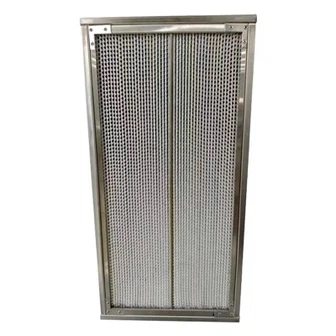
Why Must Pharmaceutical Factories Use Gel Seal HEPA Filters?
The "Zero Leakage" Requirement in GMP
According to Good Manufacturing Practice (GMP) regulations, sterile drug production areas (such as filling lines and freeze-dryer discharge zones) in pharmaceutical factories must achieve ISO Class 5 (Class 100) cleanliness . This means the number of particles ≥0.5μm per cubic meter of air must not exceed 3,520.
Traditional gasket-sealed filters have two fatal flaws:
Rubber aging: After long-term use, the gasket becomes hardened and creates small gaps.
Uneven installation: Poor flatness of the frame surface leads to incomplete sealing
Gel seal technology completely solves these problems. The knife-edge of the filter frame inserts into a trough filled with gel sealant (liquid gel) , creating a 100% leak-proof seal . This sealing method can even absorb thermal expansion and contraction stress without cracking.

How Gel Seal Technology Works
During installation, the knife-edge presses into the gel within the liquid slot. The gel deforms elastically, completely enveloping the knife-edge to form an airtight seal . The unique advantages of this design include:
Reusable: Even after repeated installation and removal, the gel recovers its sealing performance after resting
In-situ Testing: Supports PAO/DOP aerosol challenge tests to verify seal integrity
Adaptive Compensation: Counteracts pressure differential fluctuations, maintaining the seal in real-time
Critical Application Scenarios
In pharmaceutical factories, the following high-risk processes must use gel seal HEPA filters :
1. Sterile Filling Lines
The filling stage in vaccine production has extremely high requirements for particle control. For example, the lipid nanoparticles (LNP) in mRNA vaccine production are oxygen-sensitive and easily adsorb particles. After adopting gel seal laminar flow hoods, one international pharmaceutical company increased its filling line environmental monitoring pass rate from 98.7% to 100%, reducing annual product scrap losses by over $2 million .
2. Cell Therapy Product Preparation
CAR-T cell preparation requires frequent transfer of culture flasks, and pressure differential fluctuations when opening and closing pass box can reach 15Pa. The gel seal structure, through adaptive pressure compensation, controls fluctuations within ±3Pa, effectively preventing cross-contamination.
3. Freeze-Dried Powder Injection Filling
For the blind spot between freeze-dryers and filling lines, modular gel seal laminar flow hoods seamlessly connect equipment, forming a continuous clean protection zone. After implementation by a domestic biopharmaceutical company, non-conforming batches for visible particles decreased by 72%.
4. Biosafety Cabinets and Isolators
In sterile pharmaceutical manufacturing, isolation systems, and safety exhaust systems, gel seal HEPA filters have become irreplaceable due to their high strength and corrosion resistance .
In the pharmaceutical industry, gel seal HEPA filters are not an "optional configuration"-they are the last line of defense for sterility assurance. When 99.99% cleanliness is no longer sufficient to meet clinical safety requirements, gel seal technology, with its zero leakage, verifiable performance, and corrosion resistance, becomes the inevitable choice for GMP compliance and patient safety.
If you are planning a new pharmaceutical cleanroom or need to upgrade an existing contamination control system, please contact us for professional selection advice. We offer custom size gel seal HEPA filters and OEM services to meet the special requirements of different projects.