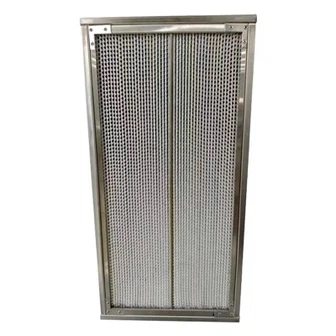
The Application of V Cell Air Filters in the Pharmaceutical Industry
Regulatory requirements in the pharmaceutical industry

GMP (Good Manufacturing Practice)
All countries around the world have mandatory requirements for the air cleanliness of the pharmaceutical production environment.
These regulations classify production areas into four grades: A, B, C, and D (ISO 5-8 levels), especially for the production and filling areas of sterile drugs (such as injections and ophthalmic preparations), which must achieve the cleanliness level of A (ISO 5 level). This can only be achieved through high-efficiency/ultra-high-efficiency air filters (HEPA/ULPA).
EN 1822
EN 1822 is a European standard applicable to high-efficiency particulate and ultra-low permeability air filters (EPA, HEPA and ULPA) used in the ventilation and air conditioning fields.
H13: MPPS efficiency ≥ 99.95%@0.3µm
H14: MPPS efficiency ≥ 99.995%@0.3µm
U15: MPPS efficiency ≥ 99.9995%@0.12µm
U16: MPPS efficiency ≥ 99.99995%@0.12µm
A-class clean areas in the pharmaceutical industry typically require the use of filters of H14 grade or higher.
ISO 14644
ISO 14644 is an international standard concerning cleanrooms and related controlled environments, mainly stipulating the technical requirements for air cleanliness.
The practical application of this standard in various industries has been widely discussed, providing guidance and support for the development of cleanroom technology.
The core parameters need to focus on when purchasing V cell filters
Pictures for v cell filters


Efficiency
The number of "V"
Initial Pressure Drop
Dust Holding Capacity
Long service life
Structural stability
Efficiency
The most commonly used filters in the pharmaceutical industry are H13 (filtration efficiency for 0.3μm particles ≥99.95%) and H14 (filtration efficiency for 0.3μm particles ≥99.995%) efficiency.
Comply with international standards such as EN 1822 (European Standard) or ISO 29463 (international Standard). These standards not only stipulate efficiency but also have strict regulations on the leak detection and testing methods of filters. After installation, PAO/DOP leak test must be conducted to ensure that there is no leakage between the filter itself and the installation frame.
V shape structure
The V-shaped structure of v cell filter enables it to provide a much larger effective filtration area in the same installation space than a panel filter (usually up to 3 to 5 times or even more). A larger filtration area means that the air passes through the filter material at a slower speed, and thus the initial resistance is smaller. Low resistance means that the supply air fan does not require such a large power, thereby significantly reducing energy consumption and saving long-term operating electricity bills.
Long service life and high stability
Due to its larger dust-holding capacity, the V cell filter clogs more slowly and has a lower replacement frequency than the panel filter, thereby reducing maintenance costs and waste generation.
The V-shaped design makes its structure more robust, enabling it to better withstand higher pressure differences and less prone to deformation or damage.
The pharmaceutical industry requires V cell air filters, it is a mandatory and necessary investment. It is the core technical equipment that meets GMP regulations, ensures the cleanliness of the drug production environment, and ultimately guarantees the quality of drugs and patient safety. Its V-shaped structure brings advantages such as large dust holding capacity, low resistance and long service life, making it the top choice for high-efficiency filters in the pharmaceutical industry.
SNYLI - A professional air filtration products manufacturer
Our free service hotline: +86 15905311280
Email: info@snyli.com

15
years
Snyli Environmental Technology (Shandong) Co.,Ltd was established in 2010, registered in Liaocheng City, Shandong Province, mainly engaged in air filtration products.
ISO
certificates
We have obtained three systems certifications.