Best Hepa Filter For Hvac
The selection and configuration of Best Hepa Filter For Hvac in the purification air conditioning system are generally rationally selected and configured according to the air cleanliness level of the clean room and the special requirements of the production process.
When the air volume of the entire purification system is processed, the number of required filters can be determined according to the rated air volume of the selected filter. Small purification equipment, such as clean workbenches, air showers, laminar flow hoods, etc., generally use coarse-effect filters or medium-effect filters on the fresh air inlet side due to the small air volume processed, and hepafilters or ultra-high-efficiency filters must be used at the air supply end.
Purification air conditioning system usually sets coarse, medium and sub-high efficiency filters in the fresh air treatment device. In the clean room circulating air system, high efficiency particulate air filter or ultra-high efficiency filters are also set; generally, high efficiency filters are located at the end of the purification air conditioning system, that is, on the ceiling of the clean room; for ultra-high efficiency filters, they must be located at the end of the purification air conditioning system to ensure the required air cleanliness level requirements. Due to the unique brittleness of glass fiber paper, the first thing to consider during use and installation is not to touch sharp objects and rub repeatedly. Secondly, glass fiber paper should be used as little as possible to avoid contact with water or other corrosive liquids to avoid affecting its normal use. Clean workshops are required to have good clean equipment. Thirdly, the reasonable use of coarse, medium and high efficiency filters ensures that each filter does not bear too heavy dust load.

----------------------------Selection of high-efficiency filters----------------------------
After years of understanding the use of air filters and related knowledge, considering that customers generally lack understanding of the selection, replacement and maintenance of air filters, we will now briefly explain the issues that general customers are concerned about, such as the maintenance and replacement cycle during the use of air filters. I hope it will help you to scientifically select 16x20x1 hepa filter. For clean room purification systems of 1000-100,000 levels, three-stage air filtration is usually used, namely coarse-efficiency, medium-efficiency and high-efficiency air filters; coarse-efficiency and medium-efficiency are generally placed in the air handling device, and the medium-efficiency air filter is placed in the positive pressure section. Sub-high-efficiency or high-efficiency filters are generally located at the end of the purification air conditioning system.
----------------------------Selection and installation of high-efficiency air filters----------------------------
High-efficiency air filters refer to air filtration devices, which are generally used in clean workshops, clean factories, laboratories and clean operating rooms. According to their working principles, air filters can be divided into primary air filters, medium-efficiency filters, hepa filter for ducted air conditioning and sub-high-efficiency models.
1. For small purification equipment such as clean workbenches, air showers, laminar flow hoods, etc., due to the small amount of air handled, coarse-efficiency filters or medium-efficiency filters are generally used on the fresh air inlet side, and high-efficiency filters or ultra-high-efficiency filters must be used at the air supply end;
2. For the selection and configuration of air filters in the purification air conditioning system, they are generally rationally selected and configured according to the air cleanliness level of the clean room and the special requirements of the production process.
A. For clean room purification systems of 1000-100,000 levels, three-stage air filtration is usually used, namely coarse-efficiency, medium-efficiency and h13 true hepa; coarse-efficiency and medium-efficiency filters are generally placed in the air handling device, and medium-efficiency filters are placed in the positive pressure section. Sub-high-efficiency or high-efficiency filters are generally located at the end of the purification air conditioning system.
B. For 100-1000 level purification air conditioning systems, coarse, medium and sub-high efficiency filters are usually set in the fresh air treatment device, and high efficiency filters or ultra-high efficiency filters are also set in the clean room circulating air system; generally, high efficiency filters are located at the end of the purification air conditioning system, that is, on the ceiling of the clean room; for ultra-hepa cartridge filter, they must be set at the end of the purification air conditioning system to ensure the required air cleanliness level requirements.
3. When the air handling volume of the entire purification system is known, the number of filters required can be determined based on the rated air volume of the selected filter.
----------------------------Air filtration for car painting----------------------------
If 5um dust is mixed with paint dust, the human eye can see the flaws caused by the dust. In order to ensure the quality of car paint, the paint shop (paint shop) of the car manufacturer uses a large number of air filters.
The painting line is generally a very long tunnel, and the car body undergoes various processes in the tunnel. The top of the entire tunnel is covered with a thick layer of non-woven fabric, and the fresh air passes through the non-woven fabric and enters the tunnel evenly. The function of this layer of non-woven fabric is to damp the flow. It has some filtering effect and is produced by the filter material manufacturer, so people are accustomed to classifying it as an h13 hepa filter air purifier. The efficiency specification of this layer of damping material is roughly equivalent to F5. The filtering efficiency is actually not important here. What is important is that the material itself should be uniform and the air outlet surface should not shed hair.
The main filter of the painting line is located above the damping layer or in the air handling unit. The effect specification of the main pre filter is F5~F7. The main filter is generally an ordinary bag filter. It is this level of filter that determines the air level of the painting tunnel, not the layer of damping material closest to the tunnel. There should also be a pre-filter before the main filter.

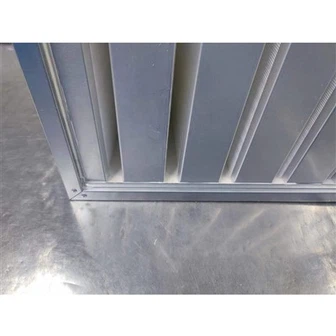
On the baking production line in the coating workshop, the air supply temperature is around 200°C. Since the heating device in the air handler may generate dust, the filter should be placed after the heating device, which requires the filter to withstand high temperatures of 200-250°C for a long time. The efficiency specifications of the filters here are generally F7-F8. All filters have a partition structure, and the glass fiber filter paper with a pleat pitch of about 8mm is separated by corrugated aluminum foil. Due to the need for high temperature resistance, the bonding and sealing between the filter paper and the metal outer frame of the filter is the key. The sealing structure must be reliable, and the cost of the sealing material cannot be too high. The sealing pads on the filter are mostly elastic glass fiber felt pads. The outer dimensions of the partition filter on the baking production line are 610×610×292mm. The hvac pre filter of the baking production line is located at the inlet end of the air supply unit, so there is no temperature resistance requirement. The pre-filter mostly uses ordinary bag filters with lower efficiency. In order to facilitate management, the pre-filter of the baking line and the air scrubber pre filter of the painting line are often of the same specifications and models.
Silicone is a very good material that can be used as a lubricant, adhesive, sealant, and even used as breast augmentation filler. Silicone is used everywhere in cars. However, the paint shop of the car factory is particularly taboo about silicone, because the paint layer will bubble when silicone is stained on the metal surface. The paint shop explicitly prohibits any silicone. The filter supplier should carefully check the various materials used in the manufacturing process, especially the adhesive, to ensure that they do not contain silicone.
----------------------------Typical filter configuration for a typical location----------------------------
Main filter for a location
Special requirements for common filter elements
Main filter in a common air conditioning unit F5~F7 ahu bag filter, non-partition filter with reasonable filtration efficiency Sanitary, protect interior decoration, protect air conditioning system
Pre-filter in a common air conditioning unit G3~F5 Various cheap, easy-to-use pre filter for air purifier with high dust holding capacity, guaranteed supply Protect air conditioning system, protect next-level filter
Main filter for high-end public places centralized air conditioning F7 pocket bag filter, non-partition filter Prevent black stains on air outlets and prevent interior decoration from fading.
----------------------------Fiber diameter, rough identification of filtration performance----------------------------
During the filtration process, fibers are obstacles that block dust. The finer the fibers, the more fibers there are per unit volume, and the higher the filtration efficiency.
The airflow moves around the fibers, generating energy consumption, which is manifested as the resistance of the filter material to the airflow. For two materials with the same filtration efficiency, the coarse fiber material has greater resistance, while the fine fiber material has less resistance.
In addition to being blocked by the fibers, dust can also be blocked by dust captured in advance, so the dust on the surface of the fiber is loosely accumulated in a "branch structure", with the fiber being the "trunk" and the dust being the "branch". The more fibers there are, the smaller the space between the fibers, the more solid the branch structure formed by the dust, and the less likely it is that the dust accumulation will be blown away and cause secondary pollution. In general, the more fibers there are, the more branch structures can be formed, the more dust can be accommodated per unit area, and the longer the service life of the filter.
In theory, as long as the fibers can still remain strong enough to resist the resistance of the airflow, the fibers of the filter material should be as fine as possible.
For two filter materials of the same thickness and fluffiness, the fine fiber filter material has high filtration efficiency, and in most cases, the fine fiber filter material has a large dust holding capacity.
For two filter materials of the same efficiency and structure, composed of different fibers, the fine fiber filter material has high resistance and low dust holding capacity.
----------------------------Service life of high-efficiency filter----------------------------
For a clean room in operation, the value of the terminal highh13 true hepa filter replacement is not high, and the total may be less than the output value of the user for two hours, but the risk and indirect cost of replacing the filter will be very high.
When replacing the filter, production must be stopped, and the loss of production stoppage can only be calculated by the owner himself, and the loss is definitely higher than the cost of spare parts for the filter. Replacing the filter is a very careful operation. Nothing in the clean room can withstand the tossing. If an inconspicuous device is damaged, the loss may be higher than the cost of all filters. After replacing the filter, it must be tested by a professional, and sometimes the air conditioning system must be debugged, and then it must go through a period of trial operation. The three costs of testing, debugging, and trial operation added together may be comparable to the price of the filter. Smart owners always want to extend the service life of high-efficiency filters as much as possible, not to save a few dollars on the filters, but to avoid a lot of trouble caused by replacing the filters.
To give an extreme example, the design service life of the high-efficiency filters at the end of the clean room of a contemporary chip factory is "a lifetime", that is, they will never worry about the high-efficiency filters after they are put into operation. The technology of that kind of factory is changing with each passing day. A new project will be outdated 5 to 7 years after it is put into production. The process must be updated, the factory building must be renovated, and the h13 air filter will also be scrapped at the same time.
When there is too much dust accumulation on the high-efficiency filter, the resistance increases. When it is so large that it affects the normal air supply, the high-efficiency filter should be scrapped. Increasing the filter area of the high-efficiency filter or increasing the number of filters can extend the service life of the filter. But the game space of those practices is not large. You can't increase the filter area indefinitely.

To extend the service life of the high-efficiency filter, the most fundamental way is to block the dust in the pre-filter. Replacing the pre-filter generally does not require stopping production or debugging, so experienced owners will spend their attention and money on the pre-filter. For cleanrooms of Class 10000 and Class 100000, F8 filters (colorimetric method 95%) can be used for pre-filtration, so that the service life of the terminal high-efficiency filter can generally reach 5 years.
For cleanrooms of Class 100, Class 10 or higher in chip factories, the common efficiency level of pre-filters is H10 (MPPS 85%), and many new projects simply use HEPA (efficiency for 0.3mm particles ≥ 99.97%). Designers claim to guarantee the use of terminal filter hepa 13 for "a lifetime", and their methods are nothing more than this.
In the design of cleanroom air conditioning systems, the common configuration of filters is: coarse efficiency → medium efficiency → high efficiency. At that time, the service life of the terminal high-efficiency filter was only 1 to 3 years, and the worst was only a few months.
In some occasions, the regulations on the service life of high-efficiency filters are not based on resistance considerations, but other factors. If there is hydrofluoric acid in the plant, and the workshop air conditioning is not a fresh air system, the glass fiber filter paper in the high-efficiency filter will be corroded by the return air. For safety, the Best Hepa Filter For Hvac must be replaced regularly. Some wealthy pharmaceutical factories replace their high-efficiency filters after the rainy season every year to prevent any possible mold contamination on the filters.
Keywords: 0.1 micron air purifier | hepa h14 air purifier | h13 hepa | h14 hepa air purifier | best room hepa air purifier | hepa 12 filter