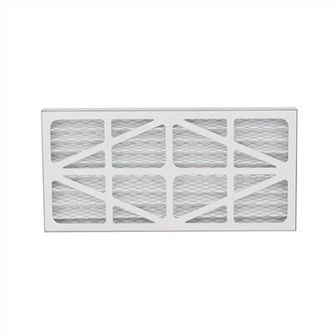
HEPA vs. ULPA: Which Filter Is Best for FFUs?
Fan Filter Units (FFUs) are essential components of many modern cleanrooms, providing filtered air to help control airborne particles and maintain the required cleanliness level. When selecting an FFU, one of the most important decisions is choosing between a HEPA filter and a ULPA filter.
Quick Answer: HEPA filters are generally the best choice for most FFUs because they provide excellent particle removal with a good balance of airflow, pressure drop, energy consumption, and cost. ULPA filters are better suited to applications that require extremely high particle control, such as semiconductor and ultra-clean manufacturing.
HEPA vs. ULPA Filters: What Is the Difference?
HEPA and ULPA filters are both high-efficiency air filters designed to remove airborne particles from controlled environments. The main difference is their filtration efficiency and the level of particle control they are designed to provide.
Common HEPA filters used in FFUs include H13 and H14 grades, while ULPA filters are commonly available in U15, U16, and U17 grades.
| Feature | HEPA Filter | ULPA Filter |
|---|---|---|
| Common grades | H13, H14 | U15, U16, U17 |
| Filtration level | Very high | Extremely high |
| Pressure drop | Generally lower | Generally higher |
| Energy consumption | Generally lower | Generally higher |
| Airflow performance | Easier to maintain high airflow | May require higher fan power |
| Typical applications | Cleanrooms, pharmaceuticals, hospitals, electronics | Semiconductor, microelectronics, ultra-clean manufacturing |
A higher filtration efficiency does not automatically mean better FFU performance. The filter must be properly matched with the fan, motor, airflow requirements, and cleanroom design.
HEPA or ULPA: Which Is Better for FFUs?
For most cleanroom FFU applications, HEPA filters offer the best overall balance of performance and operating cost.
H13 and H14 HEPA filters can provide highly efficient particle removal while maintaining suitable airflow and relatively manageable pressure drop. They are widely used in pharmaceutical manufacturing, medical environments, electronics production, laboratories, and general cleanrooms.
ULPA filters provide a higher level of filtration and are more suitable when controlling extremely fine airborne particles is critical. They are commonly considered for semiconductor manufacturing, advanced microelectronics, and other processes with very strict particle-control requirements.
When choosing a HEPA or ULPA filter for an FFU, consider:
- Required cleanroom classification
- Target particle concentration
- FFU airflow and air changes
- Initial and final pressure drop
- Fan static pressure
- Energy consumption
- Filter service life
- Process sensitivity to airborne particles
- Total cost of ownership
Using a ULPA filter where HEPA filtration is sufficient may increase pressure drop and energy consumption without providing a significant operational benefit. Conversely, using HEPA when a process requires ultra-high filtration efficiency may not provide adequate particle control.
How to Choose the Right FFU Filter for Your Cleanroom
The best FFU filter should be selected according to the actual requirements of the cleanroom and manufacturing process rather than simply choosing the highest available filtration grade.
| Application | Typical Filter Choice | Key Consideration |
|---|---|---|
| General cleanrooms | H13 / H14 HEPA | Balanced filtration and airflow |
| Pharmaceutical cleanrooms | H13 / H14 HEPA | High-efficiency particle control |
| Electronics manufacturing | H14 HEPA / ULPA | Depends on process sensitivity |
| Semiconductor manufacturing | ULPA | Extremely high particle control |
| Ultra-clean processes | ULPA | Maximum filtration performance |
Pressure drop is particularly important for FFUs. As filter resistance increases, the fan needs to generate more static pressure to maintain the required airflow. This can increase energy consumption and affect the operating cost of the cleanroom.
For this reason, filtration efficiency, airflow, pressure drop, fan performance, and energy efficiency should always be evaluated together.
Installation quality is equally important. Even a high-efficiency HEPA or ULPA filter cannot perform properly if there are leaks around the filter frame, gasket, or sealing system. Proper installation, leak testing, and airflow verification help ensure reliable FFU performance.
Conclusion: HEPA or ULPA for FFUs?
There is no single filter that is best for every FFU.
Choose HEPA when you need high filtration efficiency with a good balance of airflow, energy efficiency, and cost. For many cleanroom applications, H13 and H14 HEPA filters are an effective solution.
Choose ULPA when your manufacturing process requires extremely high particle removal and the additional pressure drop and energy requirements are acceptable.
Ultimately, the right FFU HEPA or ULPA filter should be selected based on your cleanroom classification, process requirements, airflow, pressure drop, and total operating cost.
At Snyli, we provide high-efficiency filtration solutions for cleanrooms and FFU applications. Our filtration solutions can be selected according to specific airflow, efficiency, pressure drop, and application requirements, helping customers achieve reliable and energy-efficient cleanroom performance.

Contact Snyli today for a Customized Cleanroom Filtration Solution!